Building Design Resilience:
How AI Can Support Designers' Mental Well-being
Intro
Time
May 2025 - Sept 2025 (5 months)
Team
Solo project
My role
UX designer, Front-end developer

Overview
Insipiration
As designers, we face unique anxiety...
How can we navigate it? How to build our mental resilience?
This project started from my design studies at Delft University of Technology. As an international student, adapting to a completely different culture and education system in a country is never easy. During my studies, I experienced many challenges, which caused me strong anxiety for a long time. This experience sparked my interest in mental health issues. Therefore, I decided to use this experience as a starting point for my design.

Solution
Lumi - an AI-based design reflection tool, aiming to coach students dealing with design anxiety
Lumi is a mental health support tool designed for design students’ mental well-being. It aims to help and coach on how to cope with anxiety during the design process and generate AI-enhanced personal insights throughout the design study.
Quite video introduction in case you don't want to read:)
Design process

Research process
Research background
Conversational AI was adopted here because of its potential and wide implementation for personalized mental healthcare
At first, I limited my design solutions into the AI because the technology has been widely used in delivering mental health support. AI chatbot could become a personalised “emotional coach” for design students, helping them deal with anxiety, regulate the emotions and build mental resilience.

Interview process
To build design resilience, we need to know what the typical anxieties or challenges are faced by design students.
I adopted a combination of interviews and material-based reflections to understand:
Typical anxiety faced by design students
Their inner psychological journey when experiencing anxiety and the ways and mindsets they use to overcome it.
Their preference of AI chatbots to cope with anxiety.


left: Anxiety self-assessment survey; Right: Anxiety reflection sheet
Mental journey mapping
From a psychological aspect, anxiety is usually caused by unhelpful thinking & behavior patterns, same for design students.
I asked the participants to recall one project or a scenario that they experience anxiety to know the cognitive behavior patterns behind anxiety from the psychological perspect.

Problems
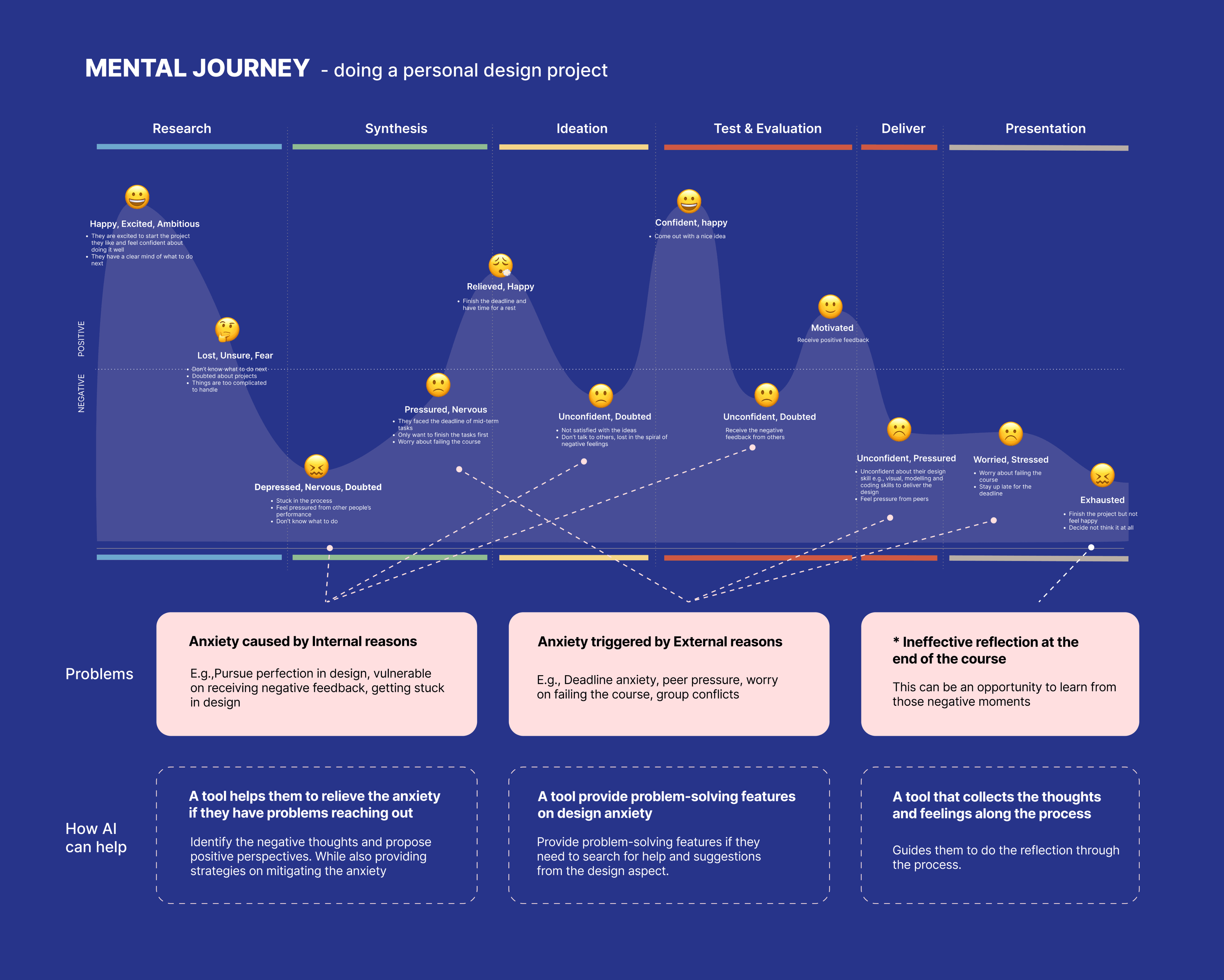
Okay, have to admit that doing a design project is sometimes a roller coaster journey.
How can we do and learn from it?
Through observation, interviews, and user research, I analyzed the psychological journey of design students during project work and summarized the main problems they encounter:
Internal causes of design anxiety: striving for perfection in design, feeling vulnerable when receiving negative feedback, or getting stuck or stagnant during the design process.
External factors include deadline anxiety, peer pressure, fear of failing a course, or conflict in group projects.
Another important finding is that students often lack effective reflection after the course (project) ends.
So, how could conversational AI help to navigate anxiety during the design process?
I also analysed how the AI chatbot can help users address specific anxiety issues throughout the process and guide them toward reflection. There are two situations:
Two situations of facing anxiety

Design opportunity
Design an AI reflection tool that assists students in coping with momentary anxiety during the design process and guides them to reflect on design journeys after each design project in order to build mental resilience.
1
An AI chatbot for reducing anxiety in real-time when they face difficulties in design.
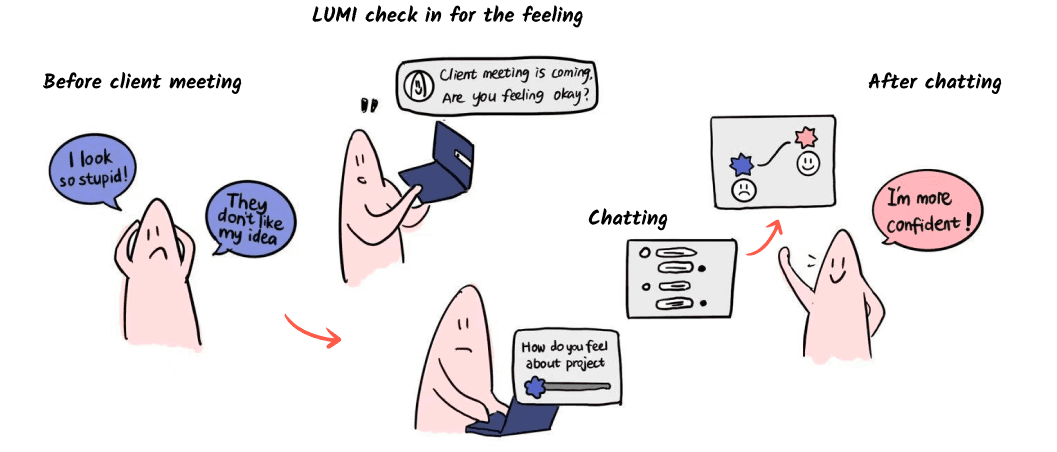
During the project, student feel anxious about the client meeting
2
Provide insights to look back on their design journey for their future design practice.

After finishing the project, student check insights of the project
Design Solution
Lumi
Lumi is a mental health support tool designed for design students’ mental well-being. It aims to help and coach on how to cope with anxiety during the design process and generate personal insights throughout the design study.

Step 1
Create the project
Create a design project that you’re doing now and add the milestones for system to send a mental health tracking reminder.
Step 2
Project feeling log in &
AI chatting
(Optional) Chat with Lumi about the feeling.
*The dialogue was pre-trained
Step 3
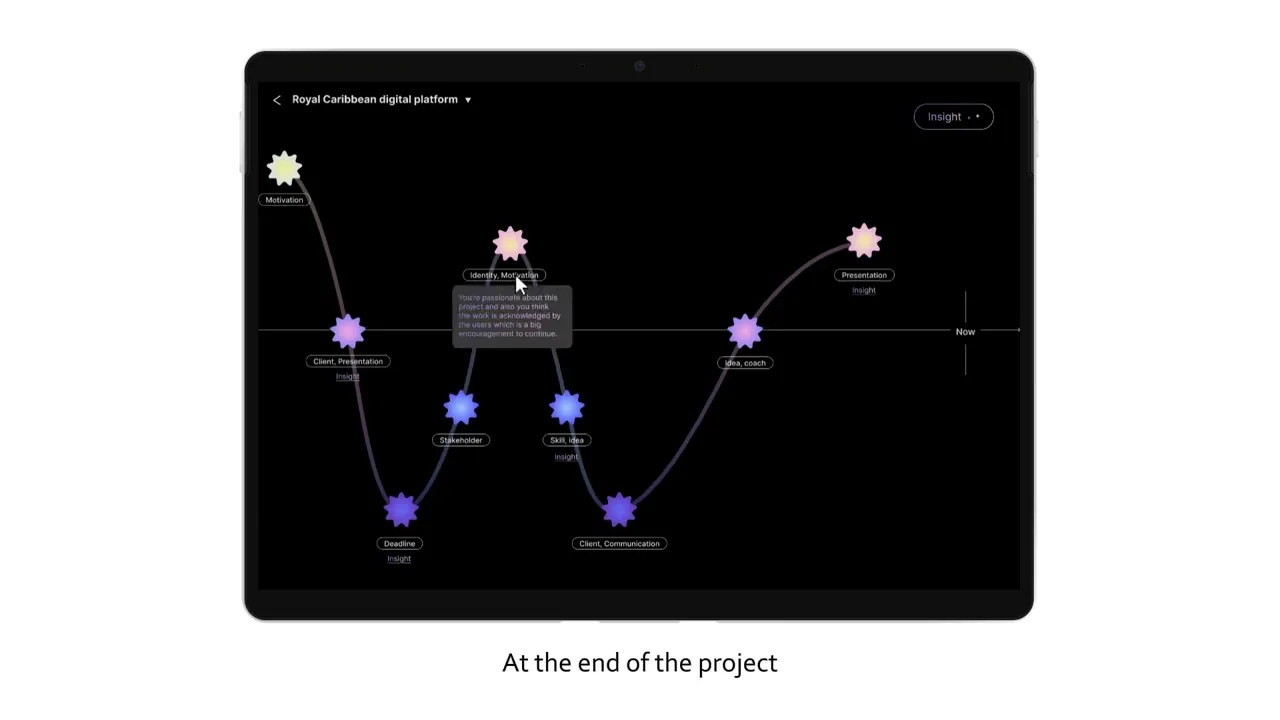
Check the project journey
It will show an emotional journey of the project on the timeline with AI insights and triggers lead to that feelings
Step 4
End-of-project reflection
(AI-generated)
Journey overview
Analysis on project feelings
Analysis on triggers behind feelings
Lumi’s recommendation
Bonus!
Overall personal insights
(AI-generated)
Design application
Lumi could be a plugin in the online design platform like Miro or Figma!
This could lower the threshold for users to use, as they don’t need to open a new website. Figma or Miro is frequently used by designers in daily lives. They are more likely to use the tool to write their reflections. And it can be easily linked to their design process.

Vibe coding
Play the prototype→ https://lumi-demo.figma.site
I used Cursor and Figma Make to recreate the interfaces I designed. Since standard design files are already available, coding in Figma Make is easier and more precise.


Prompting with Voiceflow and ChatGPTs
The prototype doesn’t integrate the OpenAI API. In order to test the result of conversations, I used Voiceflow to simulate conversational steps (indicated before), and finally, I decided to use ChatGPT to simulate the chatting (design anxiety coping + design reflection) function and compared the emotions before and after using the prototypes.
* I iterated on several versions of prompts for its best performance.
Conversational flow in Voiceflow

Evaluation
User test
Students expressed 80% willingness to use Lumi for the design study
Lumi is perceived as visually engaging and attractive, but the introduction process requires refinement. A clearer and more interactive introduction could help participants quickly understand how the tool works.


Based on 9 designers
Qualitative results
Also has high score in Attractiveness, efficiency, and novelty for the prototype
Participants rated Lumi particularly high on Attractiveness, Efficiency and Novelty, with a particular high score on feasibility, creativity and high value.

Personal Reflection
The design process of this project: A self-discovery journey
This project began as an academic exploration but evolved into a journey of self-discovery and growth. With few examples to follow, I navigated uncertainty through extensive research in psychology, learning not only about anxiety but also about myself. I realized that not every step needs an immediate purpose—sometimes intuition leads to meaningful outcomes that you never expect.
What can be improved in the future?
Adopt strategies to increase the long-term motivation: From the evaluation, people said this tool is especially helpful for short-term or new project, because they have more motivation to document the process. But for long-term project, they may lose the motivation to do it. To increase the engagement of using this tool. For example: Provide fun facts from the journey; Add more interaction with the character of Lumi.
Link emotions with project progress: Currently, the prototype only visualises emotions and its triggers on the timeline. Future versions could also add milestones or linked events, helping students clearly see “which event cause which emotion”.
Adapt for designers from multi-background: The selection of emotional factors and AI dialogue model training should be personalised for each designer group (e.g., architects and UX designers).
For the whole project process, please check —> Building Design Resilience | TU Delft Repository