Hospital Hero: Acheiving health equity for Non-Western Migrant Families in the Netherlands
Intro
Client
Time
Nov 2024 - Jan 2025 (3 months)
Team
2 UX designer
Role
Literature research, user research, ideation, Interface design
What is Hospital Hero?
Hospital Hero was designed for paediatric patients between the ages of 4 to 10 years old. The app’s intention was to reduce children’s fear and anxiety during their hospital journey from start to finish. The care journey started at home, where children and their parents were prepared for an appointment at the hospital.

Overview
The problem
The App now is only targeted for Dutch families in Dutch hospitals
Because of the language problems, other families, especially those with a non-Western background, encounter more challenges in taking their children to see the doctor.


Design challenge
How to make it more inclusive for non-Western migrant families?
In recent years, the Netherlands has seen increasing ethnic diversity among its patient populations due to migration policy. These migrant families experience other challenges than Dutch families in Dutch hospitals.

Solution
3-Step Strategy—Helping migrant families to better use Hospital hero
Attract them to download app - Waiting room design
Educate them health knowledge and hospital process - App design
Improve parents & children’s interactions - App design

Research methods
The targeted group is very special under this topic. To achieve our goal, we employed a variety of research methods to ensure a comprehensive understanding of the targeted group and to incorporate diverse perspectives.

20+ Literature research
Researched on the children's anxiety and culture difference of perceiving this problem to know more about the context
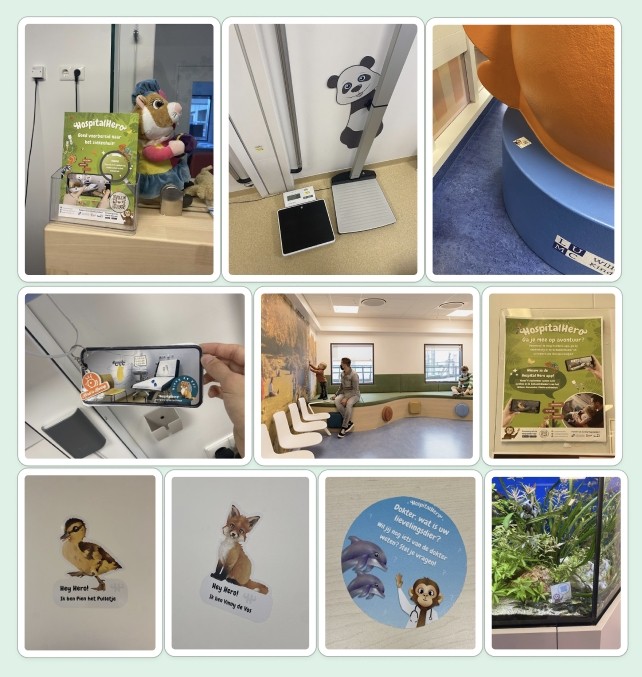
1 In-field research
Observations on how Hospital Hero is currently implemented in the hospital

7 Interviews
Experts from different fields to know the situated knowledge about inclusive children's & parents' hospital experience
Research findings
Target group portrait
The target users are Turkish, Arabic, and Syrian families.
They usually have low socioeconomic status (SES) & low health literacy.
Most of the parents didn't understand Dutch, and some only knew simple words. However, their kids usually received Dutch education and could speak Dutch but didn't understand medical terms.

Hospital service Analysis
They usually need an interpreter for hospital visit because of language barriers
The main stakeholders include children, parents, the Hospital Hero app, doctors, nurses, medical assistants, and interpreters, whose role is to help immigrant families access hospital services more smoothly.

Stakeholder map of a paediatric hospital
Hospital Journey mapping (Dutch family vs Migrant family)
Parents easily get confused in the hospital.
Parents don’t see the value of the app.
Parents are unable to ease their child’s anxiety.
Parents sometimes cannot understand doctors’ advice.

Journey map of a hospital visit (Dutch family vs migrant family)
Generally, they encountered:
Low health literacy
Don't understand much about their bodies or health
Unknown about conducted treatment and outcome
Limited understanding of how the healthcare system works in NL

Culture difference
Different understandings and experience on their child’s illness, treatment and hospital care
Tend to stay close to their child if their child is ill
Some cultures have taboos on talking about certain diseases, e.g. cancer

Perceived role in healthcare
Usually listen to the doctor for medical decisions on treatment
Don't perceive a need to get medical information and question reasons


Challenges in gaining digital healthcare (they may not have smartphones)
Compounded by additional challenges in new environment
Feel isolated due to a lack of networks or community
Socioeconomic issues

There is usually a missing or lacking way of communication even with the translator
Struggle to understand the information about their child’s treatment
Language barriers
Design opportunity
Bridge the information gap in the app between the child and parent
due to language barriers and keep their connection strong by making the app
more accessible and interactive for non-Western migration families.
Language support
There's only Dutch content in the app, giving translation support according to their need within the app so the parents could also understand it and join the interaction with the child.
Bridge the information gap
Parents were found to have a major role as information providers for children. So it would be important to give them the knowledge to educate themselves and also make them aware of the importance of preparing your child.
Reduce the complexity of information
As those families were not well digitally literate, it’s important to reduce the complex information in the app for them to understand.
Encourage parent-child interaction
Now there’re only a few parts that parents can interact with children. There was a chance to improve interactions between the parent and child for better preparation.

3-Step Strategy
From all research, there was not just one solution to make this app more inclusive. There were multiple phases where interventions were found necessary. For the concept, a strategy was created for three phases.

STEP 1: APPROACH
How can families be sensitized to Hospital Hero and be stimulated to download the app?

STEP 2: EDUCATE
How can parentification be avoided, parents feel better prepared and informed, gain confidence in their role, and know how to comfort their child?

STEP 3: INTERACT
How can Hospital hero help children start the conversation but keep them autonomous and in control?

How each step will be implemented in current service

Testimonials
“They proposed a new concept that is cultural sensitive and takes into account the different barriers, creating a multi-faceted approach to the Hospital Hero app’s experience! ”
—— Charlotte Poot, Co-founder of Hospital Hero
